



Have you ever sat in a meeting when someone asks, “Didn’t Alex fix this back in 2015?”, and the room falls silent as people do the mental math on how long it’s been since Alex left the company?
Alex left the company years ago, yet his name still guides technical decisions. The Eternal Alex Coefficient (EAC) offers a straightforward coefficient that measures how often an absent employee’s solutions continue to shape present work.
Define Y as the number of full years that have elapsed since the employee’s departure. Define T as the total number of distinct times that the employee’s name is invoked during the current calendar year.
EAC is EAC = Y × T.
When Bob left seven years ago and was still mentioned three times this quarter, his EAC stands at twenty‑one. This value grows either because the legend strengthens or because time marches on, a dynamic that rewards both narrative stickiness and organisational forgetfulness.
On a Friday afternoon, two colleagues have a chat about a potential issue.
- Didn't Mary try to solve this in 2020 ?
- What happened in the end?
- The COVID-19 pandemic. Hadn't thought about this problem since.
Now you could take this a step further and make it a league or a type of hall of fame. "It has been 5 days since we last mentioned an employee that no longer works here".
Apparently, Walsh and Ungson (1991) proposed a structure for organisational memory1, of which individuals is one of the "storage bins" of information. In other words one of the ways that organisations remember how to make better decisions is because of the specific people and their roles. 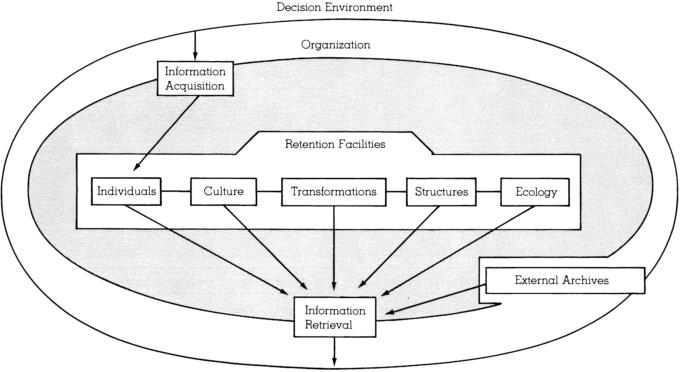
Normally this isn't a problem, if the person still works for the organisation. If the organisation hasn't transitioned to other forms of storing information and the person does not work for the organisation anymore, then that could be problematic.
This could lead to Chesteron's fence type of scenarios at the very least, where no one knows why a single or multiple individuals made a decision.
Other times the organisation might - almost - seize to function .
Walsh, J. P., & Ungson, G. R. (1991). Organizational memory. The Academy of Management Review, 16(1), 57–91.